Monday, January 26, 2015

Plotting activity of the day: SWS hunger data

From (largely) quarterly SWS data on total hunger incidence (% of households who experienced having nothing to eat at least once in the past 3 months)...


...I got this trend line with a polynomial fit (order=6) superimposed. I tried reverse engineering an existing line graph online using PlotDigitizer when I had no data to work on, but it turned out to be largely inaccurate unless the data points were identifiable.

Friday, January 2, 2015

The permanence of negative growth shocks

This recent post on Econbrowser is worth reposting in full.

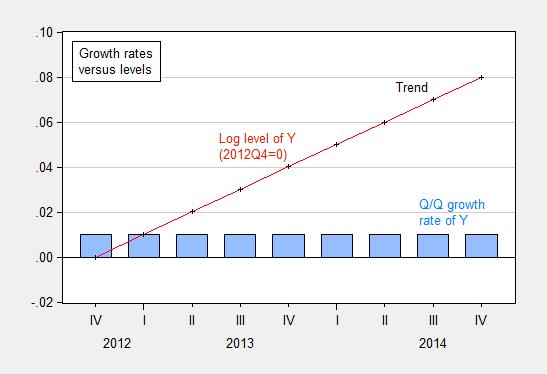
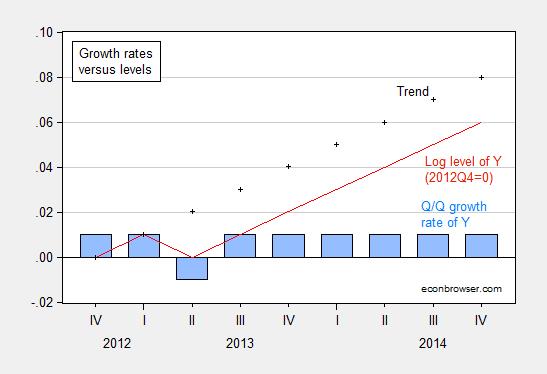
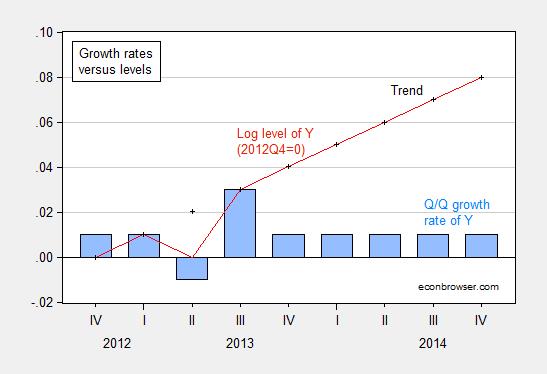
Suppose that output Y grows at 1% quarterly in log terms.

Then a 2 percentage-point drop in one quarter will permanently decrease the trend even if growth reverts back to the pre-shock level in the succeeding quarter.

The only way to revert back to the pre-shock trend is to balance the 2-ppt drop by a subsequent 2-ppt increase in a subsequent period. 

This simple illustration resonates with the economic crises experienced during the Marcos era, which undoubtedly had permanent negative effects that we are only recently counteracting with stellar growth. Our future leaders should take heed of these potential permanent effects.

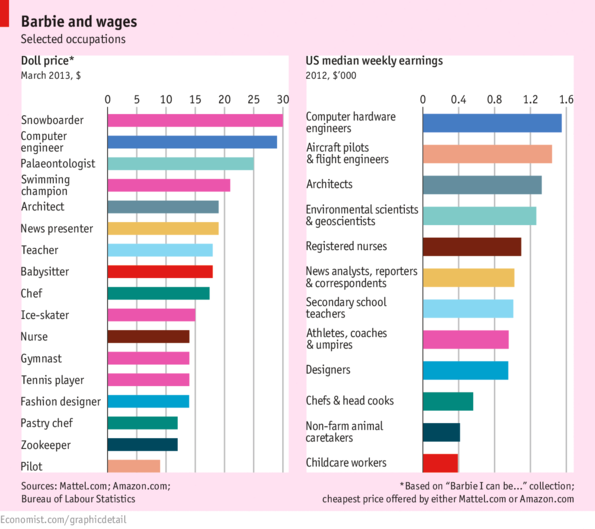
Price discrimination, illustrated

Link fiesta (1.2.15)

Happy New Year! Here's a string of links to start off the year.
  1. 2015: A big year for development. (link)
  2. The latest on the question: Does aid work? (link)
  3. Is it time to get rid of currency? (link)
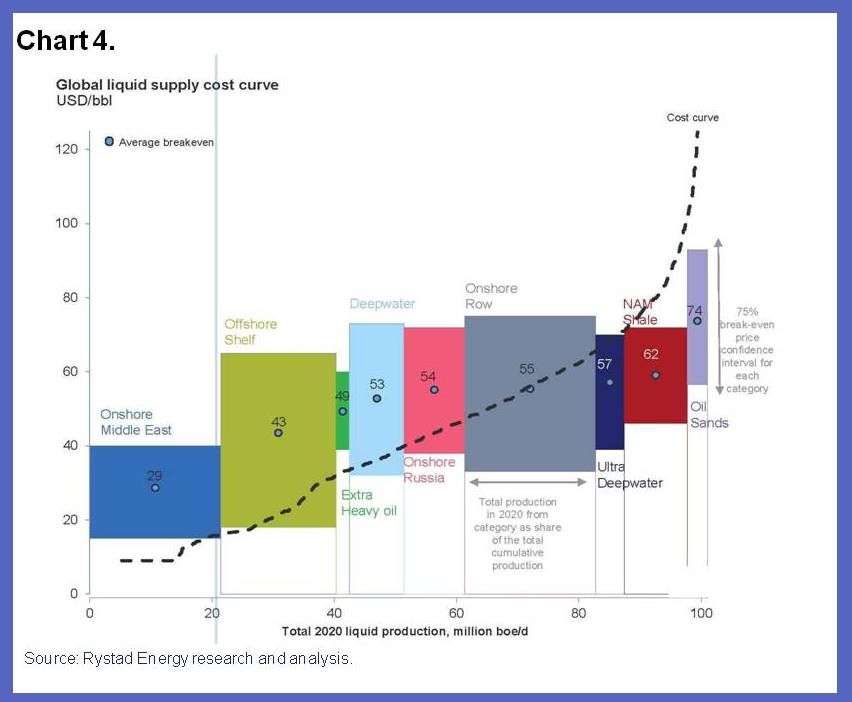
  4. Global liquid oil supply curve. (link) Also, Oliver Blanchard of the IMF and MIT on the world oil prices. (link)
  5. Mankiw on Piketty; he's not impressed. (link)
  6. Tabarrok on Piketty; it's all dependent on the fertility and bequest decisions of the rich. (link)
  7. Interview of Harvard's Raj Chetty. (link)
  8. The most influential economists c. 2014. (link, link)
  9. How will commerce be regulated/adjudicated in outer space? (link)
    1. "Their bottom line is that it is not necessary to have a government that rules outer space in order to have a recognized legal system for dispute resolution in outer space."
  10. Do children and animals avoid the sunk cost fallacy? (link)
  11. The health effects of unemployment. (link)
  12. What 2000 calories look like. (link)
  13. America's Christmas gift list 2014 (as seen in Google searches). (link)
  14. The US Census Bureau vs. academics. Underscores the critical role played by government surveys in uncovering social trends. (link)
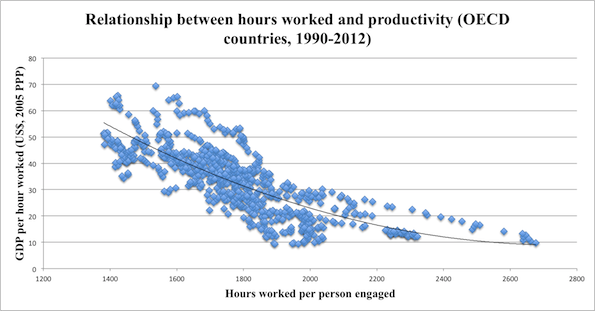
  15. Productivity decreases with work hours in OECD countries. (link)

Sunday, December 21, 2014

Explaining the plummeting gas prices

My latest Rappler article (after a 9-month hiatus) seems to be a hit!

Saturday, December 20, 2014

Harsh conditions in Apple's supply chain


A perfect illustration of the difficulties of transitioning from agriculture to industry/manufacturing.

Sunday, December 14, 2014

Link fiesta (12.15.14)

  1. OECD: inequality curbs growth. (here, here, here, here)
  2. "Debate" among top econ journals seems to have peaked in the 1960s and have been falling ever since. (link)
  3. Behavioral economics among development economists. (link)
  4. Decomposing TFP into consumption TFP and investment TFP. (link)
  5. It seems many economists don't clean up their code. (link)
  6. A history of the error term in TS econometrics. (link)
  7. Compilation of latest research on the minimum wage. (link)
  8. Uber updates. (link)
  9. On the limits of cross-country regressions. (link)
  10. Oil prices as an indicator of global economic conditions. (link)
    1. "...of the observed 45% decline in the price of oil, 19 percentage points– more than 2/5– might be reflecting new indications of weakness in the global economy."
    2. The latest on US oil production. (link, link)

Sunday, December 7, 2014

Link fiesta (12.8.14)

  1. Some claim that by end of 2014 China will be the largest economy in the world (i.e., in PPP terms). Time to rewrite the textbooks, yet again? (link)
  2. Quick tips on making research presentations. (link)
  3. "Christmas economics: a sleigh ride". (link)
  4. New book on the economics of causality (brought to you by the authors of Mostly Harmless Econometrics). (link)
  5. Amy Finkelstein's new book on moral hazard in the insurance industry. (link)
  6. Ronald Coase's impact on economics. (link)
  7. Creative destruction at work: how video stores survive in the age of Netflix. (link)
  8. How technology can reduce income inequality in the future. (link)
  9. The median household income in the US is declining, due to demographics changes and the decline in work hours per household. (link)
  10. The US has surpassed Saudi's oil production in the past 22 months. (link)
  11. The US divorce rate has also been declining. (link)
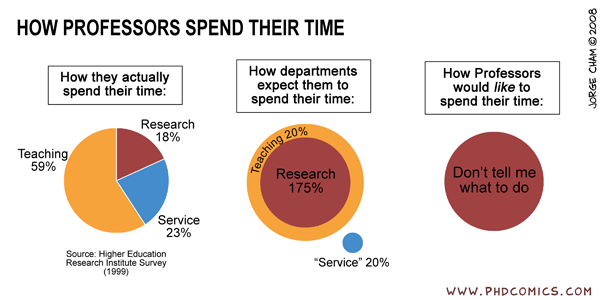
  12. PhD comics: How profs spend their time.
  13. Secular stagnation in the US. (link, link)
  14. Because of competition from Uber, medallion prices in NYC are declining. (link)

Friday, December 5, 2014

I drafted this speech!